Introduction
Quantum computing is no longer science fiction. Tech giants like Google, IBM, Microsoft, and startups worldwide are racing to build quantum computers capable of solving problems that today’s fastest supercomputers cannot handle.
But what exactly is quantum computing, and why is everyone calling it the next technological revolution?
In this article, we’ll break down quantum computing in simple language, explain how it works, explore real-world use cases, and understand how it could transform industries forever.
What Is Quantum Computing?
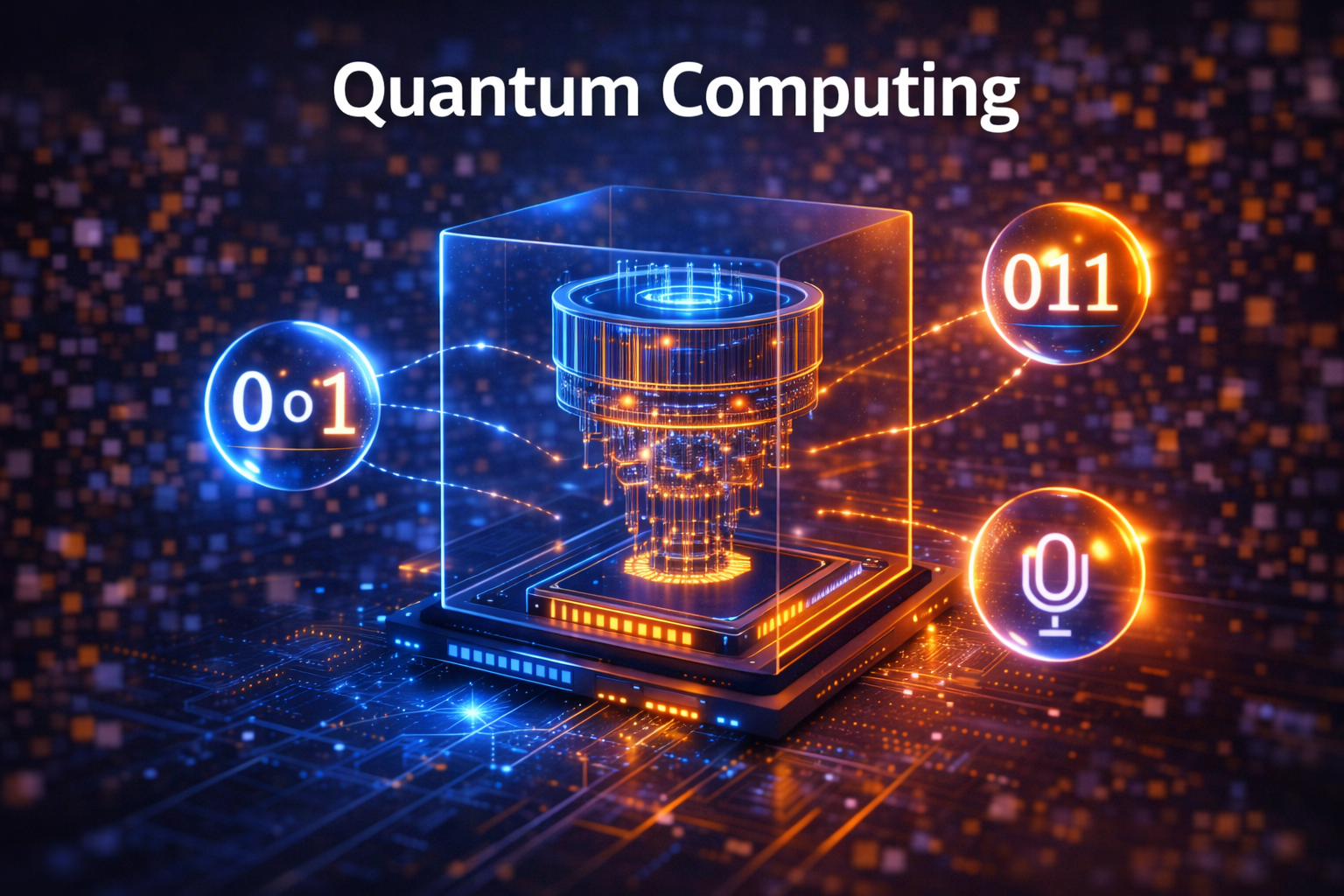
Quantum computing is a new type of computing that uses the laws of quantum physics to process information.
Traditional computers use bits, which can be either:
- 0 or
- 1
Quantum computers use qubits, which can be:
- 0
- 1
- Both at the same time
This unique behavior gives quantum computers extraordinary processing power.
Classical Computers vs Quantum Computers
| Feature | Classical Computer | Quantum Computer |
|---|---|---|
| Data unit | Bit (0 or 1) | Qubit (0, 1, or both) |
| Speed | Linear processing | Exponential processing |
| Power | Limited by hardware | Massive parallelism |
| Best for | Everyday tasks | Complex simulations |
This difference allows quantum computers to solve problems that would take classical computers millions of years.
How Do Quantum Computers Work?
Quantum computing relies on three key principles:
1. Superposition
Qubits can exist in multiple states at once, enabling massive parallel calculations.
2. Entanglement
Qubits become linked, so the state of one instantly affects another, even at long distances.
3. Quantum Interference
Helps amplify correct answers while canceling incorrect ones.
Together, these principles allow quantum computers to perform incredibly complex calculations efficiently.
Why Quantum Computing Is So Powerful
Quantum computers can:
- Process massive datasets instantly
- Solve complex mathematical problems
- Simulate natural systems accurately
- Break advanced encryption methods
This makes them a game-changer for science, security, and AI.
Real-World Applications of Quantum Computing
1. Drug Discovery & Healthcare
Quantum computers can simulate molecular interactions, helping scientists:
- Discover new medicines faster
- Design personalized treatments
- Predict protein structures
2. Artificial Intelligence
Quantum computing could supercharge AI by:
- Training models faster
- Handling complex data patterns
- Improving optimization problems
3. Cybersecurity
Quantum computing can both:
- Break traditional encryption
- Create quantum-safe encryption for future security
4. Climate & Weather Modeling
Quantum simulations help predict:
- Climate change impacts
- Extreme weather patterns
- Energy efficiency improvements
5. Financial Modeling
Banks and financial institutions use quantum computing for:
- Risk analysis
- Fraud detection
- Portfolio optimization
Challenges Facing Quantum Computing
Despite its promise, quantum computing still faces hurdles:
- Extremely expensive hardware
- Requires ultra-cold environments
- High error rates in calculations
- Limited real-world availability
That’s why quantum computers are mostly used in research labs today.
When Will Quantum Computing Become Mainstream?
Experts predict:
- Next 5 years: Research and limited commercial use
- 10–15 years: Industry-level applications
- 20+ years: Possible consumer impact
Quantum computing will evolve gradually, not overnight.
Should You Learn Quantum Computing?
If you’re interested in future-proof skills, quantum computing is worth exploring — especially if you work in:
- Software development
- Data science
- AI & machine learning
- Cybersecurity
- Physics or engineering
Even basic knowledge will be valuable in the coming years.
Final Thoughts
Quantum computing has the potential to reshape technology as we know it. While it’s still in its early stages, its impact on AI, medicine, cybersecurity, and science will be enormous.
Understanding quantum computing today puts you ahead of the curve tomorrow.
AI in Smartphones: How Artificial Intelligence Is Transforming Mobile Experience in 2026 click here…
Best AI Tools for Everyday Users in 2026: Simple, Powerful & Time-Saving click here…
AI Agents Explained: How Autonomous AI Is Changing Work in 2026 click here…
One thought on “Quantum Computing Explained: How It Will Transform Technology in the Future”