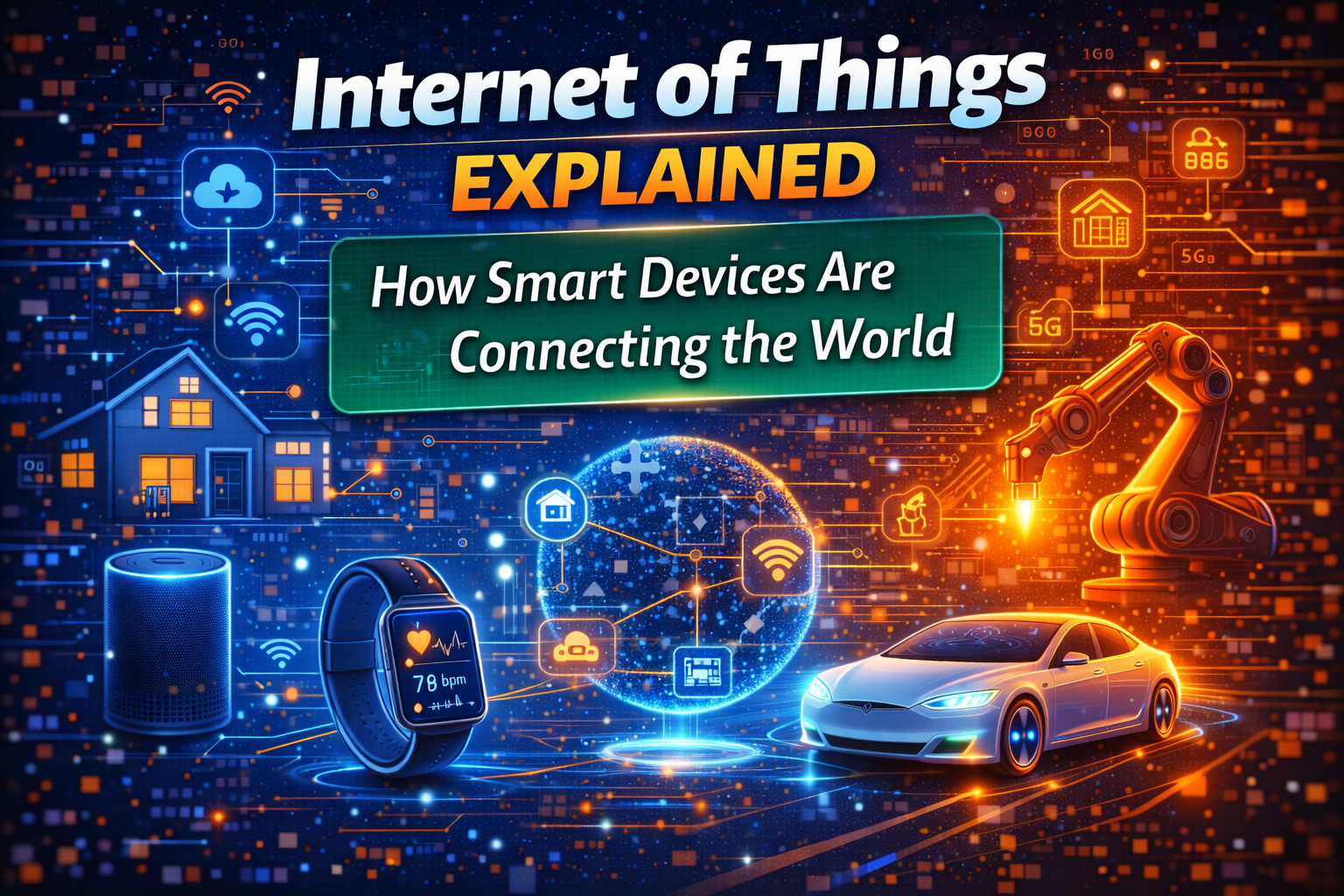
The Internet of Things (IoT) is transforming how devices, systems, and people interact. In 2026, billions of smart devices are connected to the internet, collecting data and communicating automatically to improve efficiency, comfort, and decision-making.
This article explains what IoT is, how it works, real-world applications, benefits, challenges, and future trends.
What Is the Internet of Things (IoT)?
The Internet of Things refers to a network of physical devices embedded with sensors, software, and connectivity that allows them to collect and exchange data over the internet.
Examples of IoT devices include:
- Smart home appliances
- Wearable health devices
- Smart city sensors
- Industrial machines
- Connected vehicles
These devices work together to automate tasks and provide real-time insights.
How IoT Works
IoT systems follow a simple process:
- Sensors collect data (temperature, movement, location, etc.)
- Connectivity sends data to cloud or edge systems
- Data Processing analyzes the information
- Action is triggered automatically or through user control
AI and machine learning enhance IoT by making systems smarter and predictive.
Popular IoT Applications in 2026
🏠 Smart Homes
IoT enables smart lighting, thermostats, security cameras, and voice assistants.
🏙️ Smart Cities
Traffic management, waste monitoring, street lighting, and public safety use IoT sensors.
🏭 Industrial IoT (IIoT)
Factories use IoT to monitor equipment, predict maintenance, and optimize production.
🏥 Healthcare
IoT devices track patient vitals, enable remote monitoring, and support telemedicine.
🚜 Agriculture
Smart farming uses IoT for soil monitoring, irrigation control, and crop management.
Benefits of IoT Technology
IoT provides multiple advantages:
- Real-time monitoring
- Automation and efficiency
- Reduced operational costs
- Better decision-making
- Improved safety and convenience
Businesses and individuals benefit from data-driven insights.
Role of AI and Edge Computing in IoT
In 2026, IoT relies heavily on:
- AI to analyze large data sets and predict outcomes
- Edge computing to process data near devices for faster response
This combination reduces latency and improves reliability.
Security and Privacy Challenges
IoT also introduces risks:
⚠️ Security Vulnerabilities
Poorly secured devices can be hacked.
⚠️ Data Privacy
Large amounts of personal data are collected.
⚠️ Device Management
Updating and maintaining millions of devices is complex.
Strong encryption, regular updates, and secure networks are essential.
Future of IoT
By 2030:
- IoT devices will exceed tens of billions
- Smart cities will become standard
- AI-powered IoT will be fully autonomous
- Connectivity will rely on 5G and beyond
IoT will become invisible but essential infrastructure.
Final Thoughts
The Internet of Things is connecting the world like never before. From homes and cities to industries and healthcare, IoT is improving efficiency, safety, and quality of life.
As technology advances, IoT will continue to shape a smarter, more connected future.
Blockchain Beyond Cryptocurrency: Real-World Use Cases in 2026 click here..
Autonomous Vehicles Explained: How Self-Driving Cars Will Change Transportation click here..
Wearable Technology in 2026: Smart Devices Shaping the Future click here..


2 thoughts on “Internet of Things (IoT): How Smart Devices Are Connecting the World”