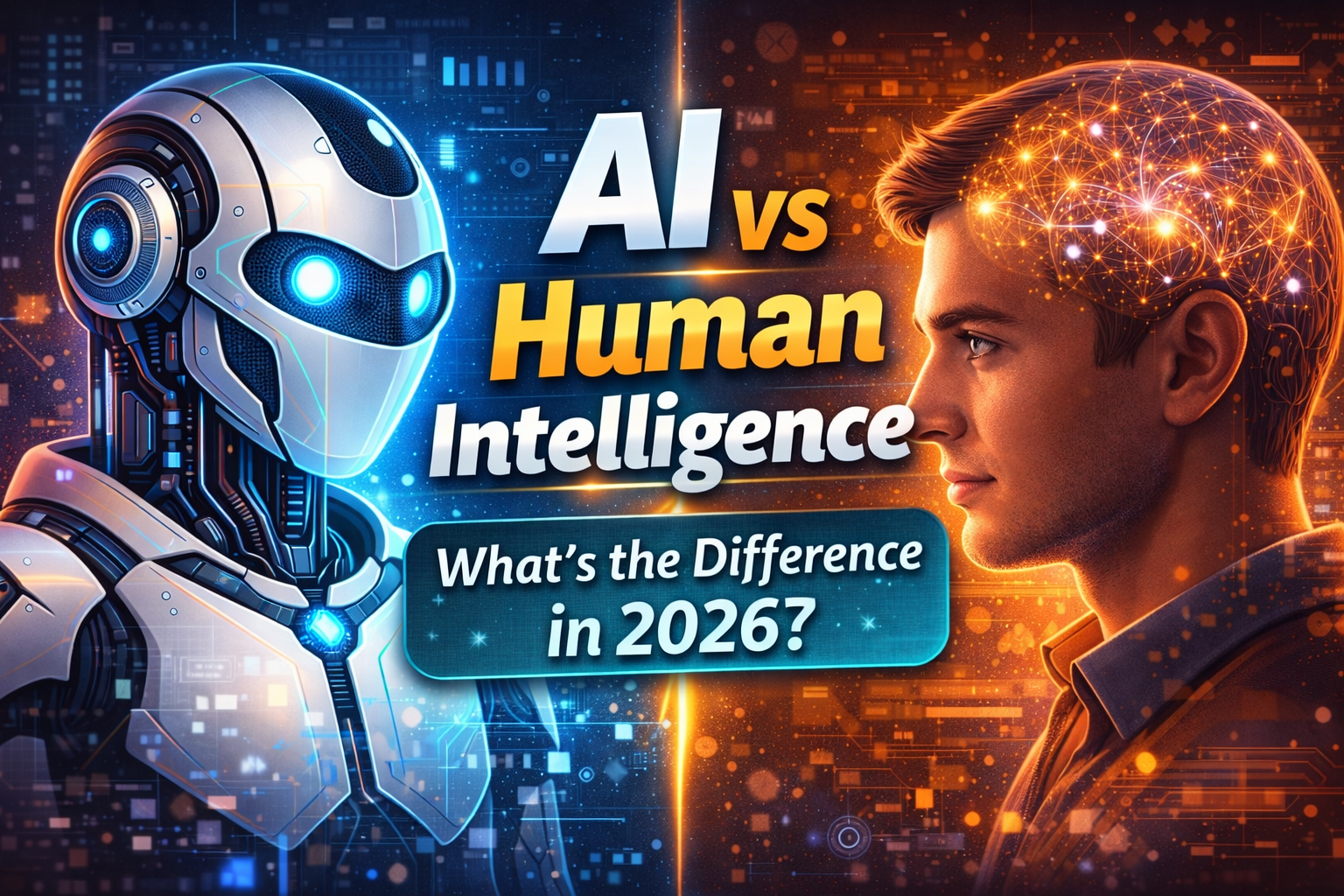
Artificial Intelligence (AI) is advancing faster than ever. From writing content to driving cars and diagnosing diseases, AI is becoming a part of everyday life. This raises an important question: How is AI different from human intelligence—and can it ever replace us?
In this article, we’ll clearly explain AI vs Human Intelligence, their differences, strengths, limitations, and what the future looks like in 2026 and beyond.
What Is Artificial Intelligence?
Artificial Intelligence refers to machines or software that can perform tasks that normally require human intelligence.
Examples of AI include:
- Chatbots and virtual assistants
- Recommendation systems like Netflix and YouTube
- Image and voice recognition
- Autonomous vehicles
- AI agents that work independently
AI systems learn from data, patterns, and algorithms. They do not have emotions, consciousness, or self-awareness.
What Is Human Intelligence?
Human intelligence is the natural cognitive ability of humans to think, reason, feel emotions, learn from experience, and adapt creatively.
Human intelligence includes:
- Emotional understanding
- Moral judgment
- Creativity and imagination
- Conscious decision-making
- Common sense reasoning
Humans learn through experience, emotions, and social interaction, not just data.
AI vs Human Intelligence: Key Differences
| Feature | Artificial Intelligence | Human Intelligence |
|---|---|---|
| Learning | From data and algorithms | From experience and emotions |
| Emotions | No emotions | Has emotions |
| Creativity | Limited and pattern-based | Highly creative |
| Speed | Extremely fast | Slower than machines |
| Consciousness | Not conscious | Fully conscious |
| Adaptability | Task-specific | Broad and flexible |
| Ethics & Morality | Rule-based | Value-based |
Where AI Is Better Than Humans
AI clearly outperforms humans in certain areas.
Speed and Accuracy
AI can process millions of data points in seconds without fatigue.
Repetitive Tasks
AI excels at repetitive work like data entry, monitoring, and automation.
Pattern Recognition
AI is extremely effective at detecting patterns in:
- Medical scans
- Financial fraud
- Large datasets
Where Humans Are Better Than AI
Despite AI’s power, humans remain superior in critical areas.
Emotional Intelligence
Humans understand emotions, empathy, and social behavior.
Creativity
Original ideas, imagination, and innovation are still human strengths.
Ethics and Judgment
Humans can make moral decisions in complex and uncertain situations.
Adaptability
Humans can adjust to new environments without prior training data.
Can AI Replace Human Intelligence?
The simple answer is no.
AI can assist, enhance, and automate tasks, but it cannot fully replace human intelligence because:
- It lacks emotions and consciousness
- It depends entirely on data
- It cannot think independently like humans
The future is not AI vs Humans, but AI and Humans working together.
AI and Humans Working Together in the Future
In 2026 and beyond, the most successful systems will combine:
- AI’s speed and efficiency
- Human creativity and decision-making
Examples include:
- Doctors using AI for diagnosis
- Developers using AI coding assistants
- Teachers using AI for personalized learning
- Businesses using AI for smarter decisions
Is AI a Threat to Human Jobs?
AI will replace some tasks, not entire professions.
Jobs most affected:
- Repetitive office roles
- Data processing
- Basic customer support
Jobs that will grow:
- AI development
- Cybersecurity
- Data analysis
- Creative and strategic roles
Learning new skills is the best way to stay relevant.
Final Thoughts
AI is powerful, but it is not human.
Human intelligence remains unique because of:
- Emotions
- Creativity
- Ethics
- Consciousness
In 2026, success belongs to those who understand AI and use it wisely, rather than fear it.
How AI Agents Work: A Step-by-Step Beginner Guide click here..
Best AI Tools for Students in 2026 (Free & Paid) click here..
How AI Is Replacing Repetitive Jobs (And Creating New Ones) click here..
2 thoughts on “AI vs Human Intelligence: What’s theReal Difference in 2026?”