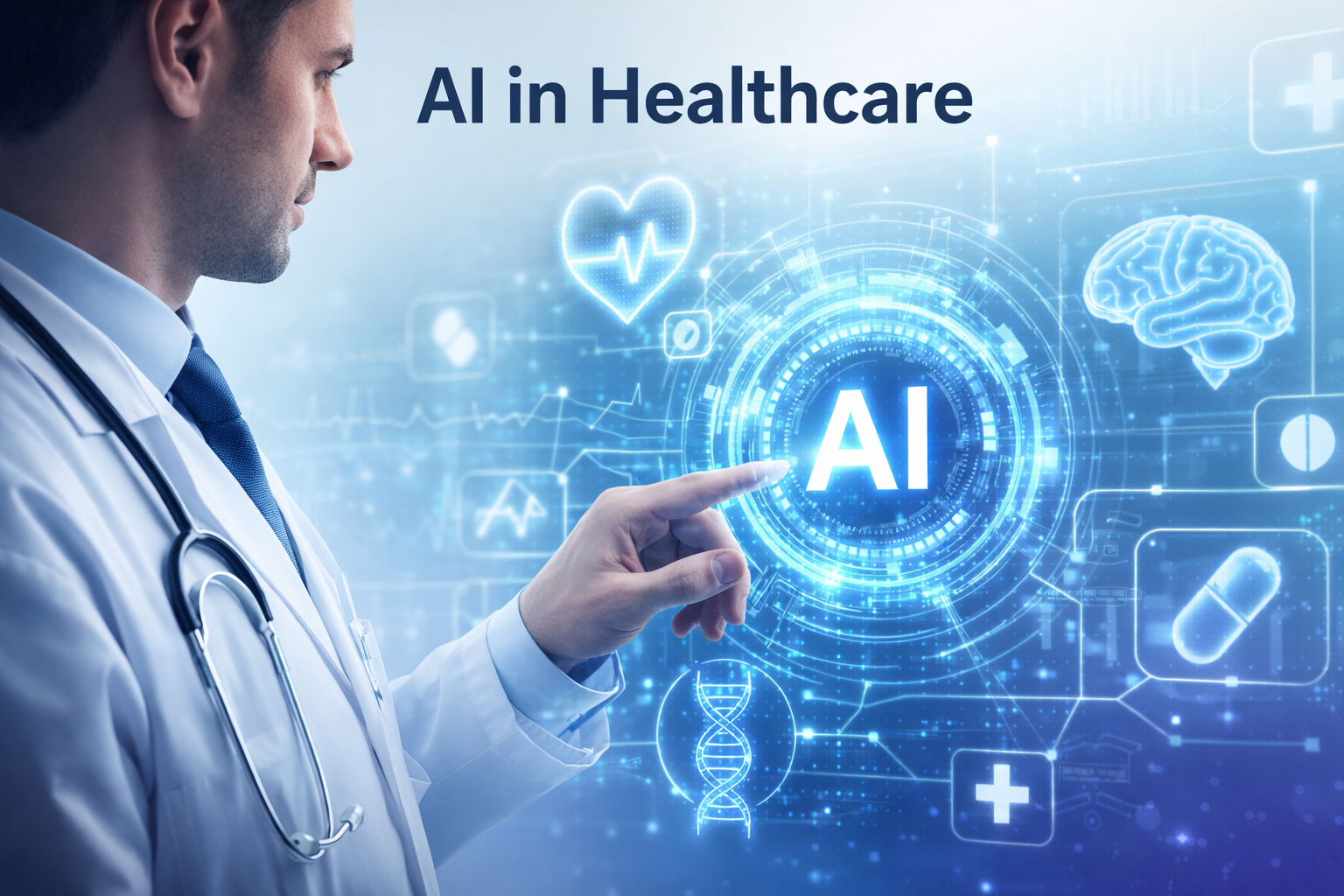
Artificial Intelligence (AI) is no longer limited to tech companies—it is now revolutionizing healthcare. From faster diagnoses to personalized treatments, AI is reshaping how doctors, hospitals, and patients experience medical care.
In this article, we explore how AI is transforming healthcare in 2026, real-world use cases, benefits, and challenges.
🏥 What Is AI in Healthcare?
AI in healthcare refers to the use of machine learning, deep learning, and data analytics to:
- Analyze medical data
- Assist doctors in decision-making
- Automate routine healthcare tasks
AI systems learn from vast amounts of medical data to deliver accurate and efficient results.
🤖 Key Applications of AI in Healthcare
🔹 1. AI-Powered Medical Diagnosis
AI tools can analyze:
- X-rays
- MRIs
- CT scans
They help detect diseases like cancer, heart conditions, and neurological disorders earlier and more accurately.
🔹 2. Personalized Treatment Plans
AI analyzes patient history, genetics, and lifestyle data to:
- Recommend customized treatments
- Improve patient outcomes
This approach is known as precision medicine.
🔹 3. Virtual Health Assistants
AI chatbots and virtual nurses:
- Answer patient queries
- Schedule appointments
- Provide medication reminders
They improve patient engagement and reduce workload for healthcare staff.
🔹 4. Drug Discovery & Research
AI accelerates drug discovery by:
- Simulating chemical reactions
- Identifying potential drug candidates
This reduces development time from years to months.
📊 Benefits of AI in Healthcare
- Faster and more accurate diagnoses
- Reduced healthcare costs
- Improved patient care
- Less administrative burden
- Better resource management
AI helps doctors focus more on patients and less on paperwork.
⚠️ Challenges & Ethical Concerns
- Patient data privacy
- AI bias in medical decisions
- Regulatory approvals
- Dependence on quality data
Ethical AI practices are essential to ensure fairness and safety.
🌍 Real-World Use Cases in 2026
| Area | AI Use |
|---|---|
| Radiology | Image-based diagnosis |
| Hospitals | Predictive patient care |
| Pharma | Drug development |
| Telemedicine | Remote diagnosis |
AI adoption is growing rapidly across the healthcare ecosystem.
🔮 Future of AI in Medicine
The future will include:
- AI-assisted surgeries
- Fully automated diagnostics
- AI-powered preventive healthcare
- Integration with wearable devices
Healthcare will become more proactive than reactive.
✨ Final Thoughts
AI is transforming healthcare by making medicine smarter, faster, and more personalized. While challenges remain, responsible AI implementation will lead to a healthier and more efficient future.
AI in healthcare is not about replacing doctors—it’s about empowering them.
Best AI Tools for Developers in 2026 (Free & Paid) click here….
What Are AI Agents? How Autonomous AI Will Change Work in 2026 click here…
Enterprise AI: How Businesses Are Using AI at Scale click here…