🧠 Introduction: A New Era of Artificial Intelligence
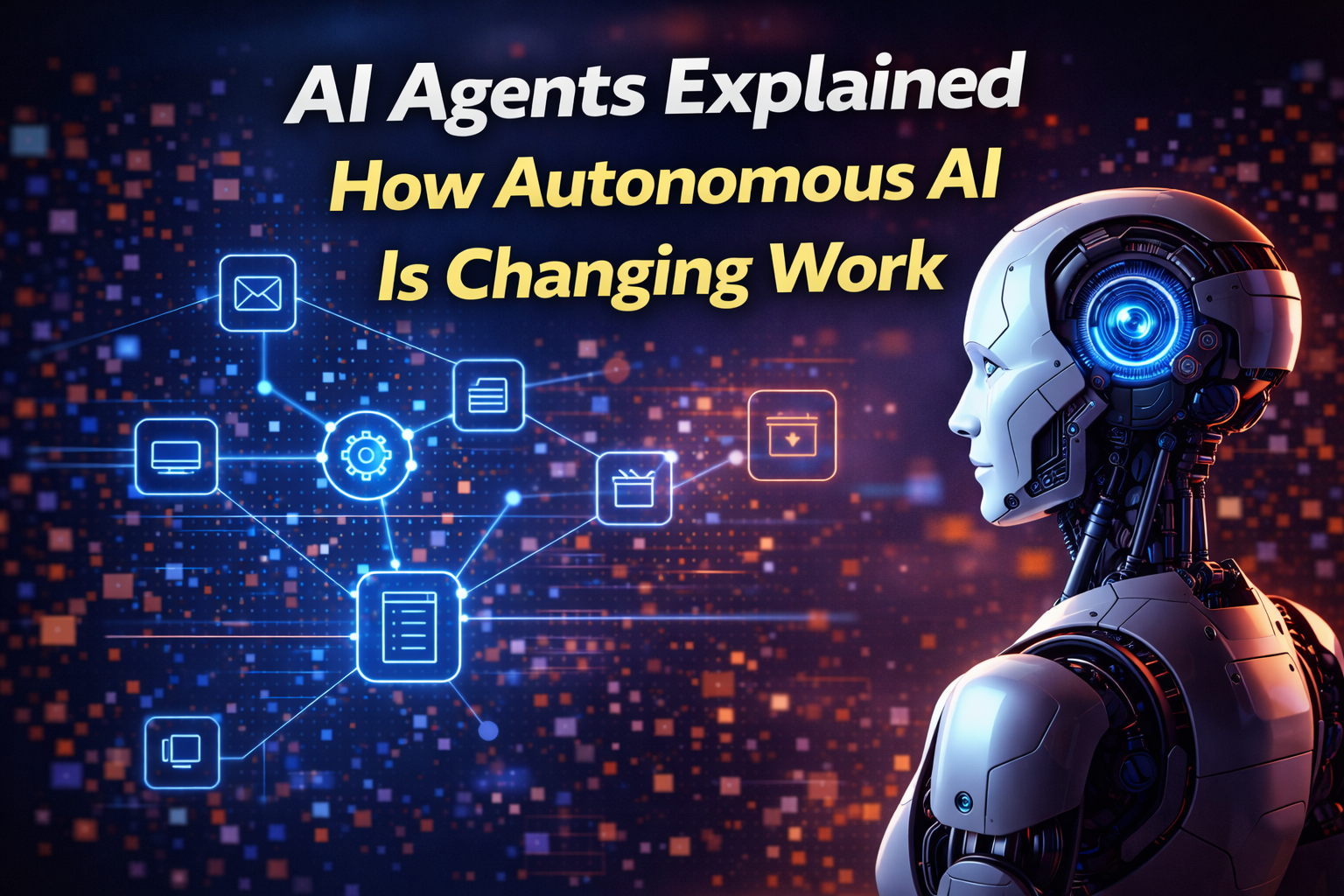
Artificial Intelligence has moved far beyond simple chatbots and recommendation systems. In 2026, one of the most powerful and disruptive developments in AI is the rise of AI agents.
AI agents are not just tools that respond to commands — they are autonomous systems capable of planning, reasoning, and taking action on their own. From managing workflows to writing code and handling customer service, AI agents are quietly reshaping how work gets done across industries.
But what exactly are AI agents? How do they work? And should we be worried about jobs?
Let’s break it down step by step.
🤖 What Are AI Agents?
An AI agent is a software system that can:
- Understand goals
- Analyze information
- Make decisions
- Take actions
- Learn from outcomes
Unlike traditional AI tools that require continuous human input, AI agents can operate independently once given a task or objective.
Simple Example:
Instead of telling an AI:
“Write this email”
You tell an AI agent:
“Handle my customer emails today”
The agent then:
- Reads incoming emails
- Understands intent
- Drafts replies
- Sends responses
- Escalates complex issues
All without constant supervision.
⚙️ How Do AI Agents Work?
AI agents combine multiple technologies working together:
🔹 1. Large Language Models (LLMs)
These allow agents to understand and generate human-like language.
🔹 2. Decision-Making Logic
AI agents decide what to do next based on goals and context.
🔹 3. Tool Access
Agents can use:
- APIs
- Databases
- Browsers
- Software tools
🔹 4. Memory & Learning
They remember past actions and improve over time.
This makes AI agents far more powerful than traditional automation tools.
🏢 Real-World Use Cases of AI Agents
📧 1. Workplace Productivity
AI agents can:
- Schedule meetings
- Manage calendars
- Write reports
- Organize tasks
💻 2. Software Development
Developers use AI agents to:
- Write and debug code
- Deploy applications
- Monitor servers
- Fix errors automatically
🛒 3. Customer Support
AI agents handle:
- Live chat
- Email support
- Ticket prioritization
- 24/7 assistance
📊 4. Business Operations
Companies use agents for:
- Data analysis
- Sales forecasting
- Inventory management
- Financial reporting
🚀 Benefits of AI Agents in the Workplace
✅ Increased Efficiency
Tasks that take hours can be completed in minutes.
✅ Cost Reduction
Businesses save money on repetitive work.
✅ Scalability
AI agents can handle thousands of tasks simultaneously.
✅ Faster Decision-Making
Real-time analysis leads to quicker actions.
⚠️ Are AI Agents a Threat to Jobs?
This is the most common concern — and the answer is complex.
❌ Jobs at Risk:
- Repetitive administrative roles
- Basic data entry
- Simple customer support
✅ Jobs That Will Grow:
- AI supervisors
- Prompt engineers
- Strategy roles
- Creative & human-centric jobs
AI agents replace tasks, not humans. People who learn to work with AI will be in high demand.
🤝 Humans + AI Agents: The Future of Work
The future workplace will not be human vs AI.
It will be:
Human intelligence + AI agents
Humans will focus on:
- Creativity
- Ethics
- Strategy
- Emotional intelligence
AI agents will handle:
- Repetitive tasks
- Data-heavy work
- Automation
This collaboration will define successful careers in 2026 and beyond.
🔮 What’s Next for AI Agents?
In the coming years, AI agents will:
- Become more autonomous
- Work across multiple platforms
- Communicate with other AI agents
- Handle complex business goals
Companies that adopt AI agents early will gain a massive competitive advantage.
🏁 Final Thoughts
AI agents are not science fiction — they are already here. They are transforming how work is done, improving productivity, and redefining job roles.
Instead of fearing AI agents, the smartest move is to understand them, adapt to them, and learn how to use them effectively.
The future of work belongs to those who collaborate with AI — not compete against it.
Internet of Things (IoT): How Smart Devices Are Connecting the World click here…
Autonomous Vehicles Explained: How Self-Driving Cars Will Change Transportation click here…
How AI Is Changing Jobs in 2026: Opportunities & Risks click here…