🌐 Introduction: Mobile Networks Are Evolving Faster Than Ever
The evolution of mobile networks has transformed how we communicate, work, and live. From 2G calls to 5G-powered smart cities, each generation has brought massive changes.
Now, while 5G is still expanding globally, researchers are already working on 6G, the next-generation wireless technology expected to redefine connectivity once again.
So what is the real difference between 5G and 6G, and why does it matter?
Let’s break it down in simple terms.
📡 What Is 5G?
5G is the fifth generation of mobile network technology designed to deliver:
- Faster internet speeds
- Lower latency
- Greater network capacity
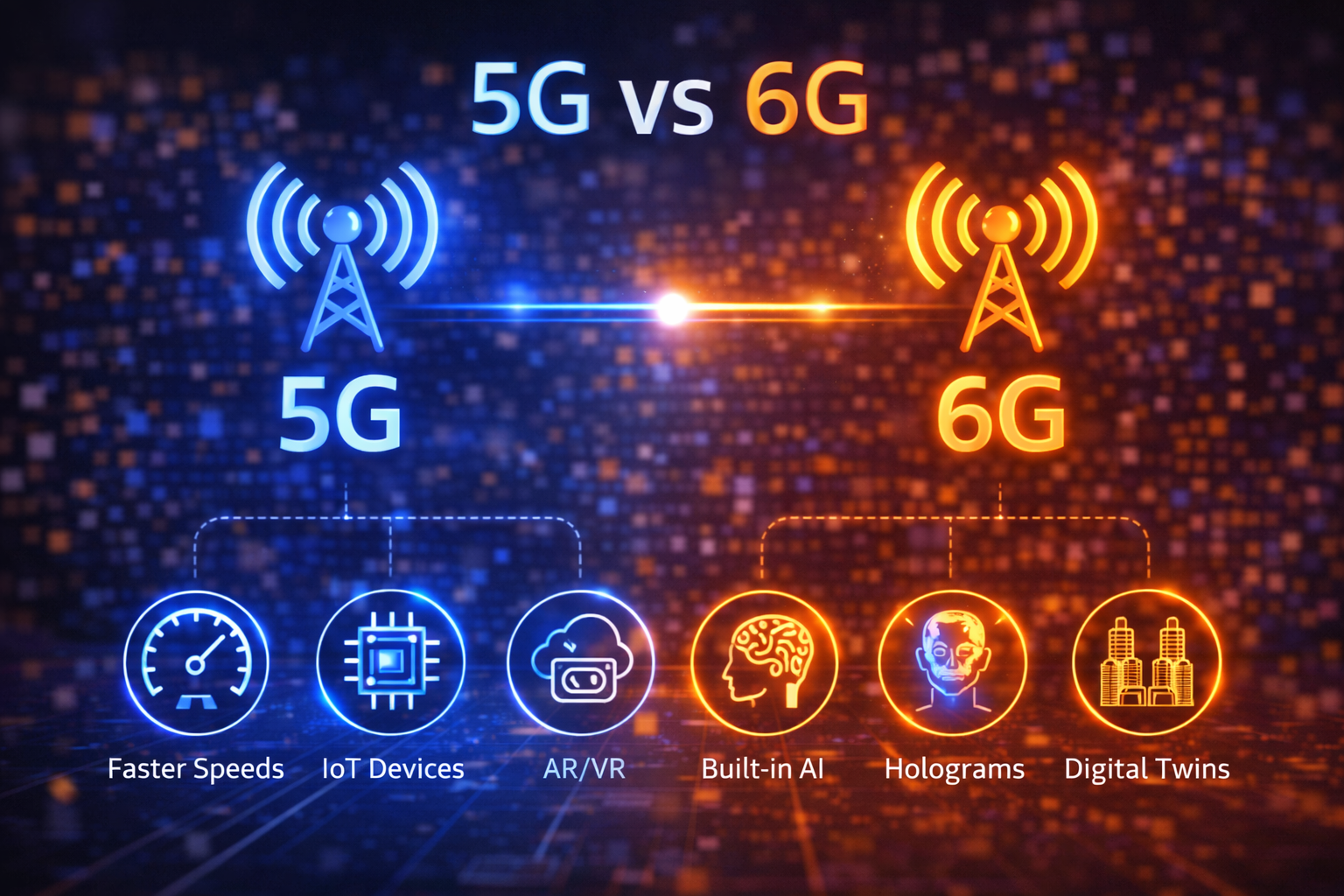
- Better connectivity for IoT devices
🚀 Key Benefits of 5G:
- Speeds up to 10 Gbps
- Ultra-low latency (as low as 1 ms)
- Supports smart cities, AR/VR, and autonomous vehicles
5G is currently powering modern smartphones, smart homes, and connected devices.
🌍 What Is 6G?
6G is the sixth generation of wireless technology, still in the research phase, expected to launch commercially around 2030.
6G aims to go far beyond speed by integrating:
- Artificial Intelligence
- Holographic communication
- Advanced sensing technologies
It will create a fully intelligent, hyper-connected world.
⚖️ 5G vs 6G: Key Differences
| Feature | 5G | 6G |
|---|---|---|
| Maximum Speed | Up to 10 Gbps | Up to 1 Tbps |
| Latency | ~1 ms | Microseconds |
| AI Integration | Limited | Built-in AI |
| Use Cases | IoT, AR, Smart cities | Holograms, Digital twins |
| Launch Period | 2020–2025 | Around 2030 |
6G is not just faster—it’s smarter.
🤖 Role of AI in 6G Networks
One of the biggest differences is AI-native architecture.
6G networks will:
- Self-optimize automatically
- Predict network demand
- Reduce energy consumption
- Improve security in real time
AI will manage the entire network without human intervention.
🧠 New Use Cases Enabled by 6G
🧬 1. Holographic Communication
Real-time 3D hologram calls could replace video calls.
🚗 2. Autonomous Transportation
Fully autonomous vehicles communicating instantly.
🏥 3. Advanced Healthcare
Remote surgeries and real-time patient monitoring.
🌐 4. Digital Twins
Virtual replicas of cities, factories, and humans.
🔋 Energy Efficiency & Sustainability
6G aims to be:
- More energy-efficient
- Environmentally sustainable
- Optimized for low power devices
This is crucial as billions of devices come online.
🔐 Security Improvements in 6G
6G will introduce:
- AI-driven threat detection
- Quantum-resistant encryption
- Zero-trust network models
Security will be built directly into the network layer.
⚠️ Challenges Facing 6G Development
Despite its promise, 6G faces major challenges:
- Extremely high infrastructure costs
- New spectrum requirements
- Regulatory approvals
- Global standardization
These challenges explain why 6G is still years away.
📅 When Will 6G Be Available?
- 2024–2027: Research & testing
- 2028–2029: Standardization
- 2030: Early commercial rollout
Until then, 5G will continue to evolve with improvements like 5G Advanced.
🏁 Final Thoughts
5G is revolutionizing connectivity today, but 6G represents a vision of a fully intelligent digital future.
While 6G may still be years away, understanding its potential helps businesses, developers, and consumers prepare for what’s coming next.
The journey from 5G to 6G isn’t just about speed—it’s about transforming how humans and machines connect.
Web3 Explained: How Decentralization Is Changing the Internet Forever click here…
On-Device AI Smartphones Explained: What Makes Them Different in 2026? click here…
Best AI Tools for Everyday Users in 2026: Simple, Powerful & Time-Saving click here…