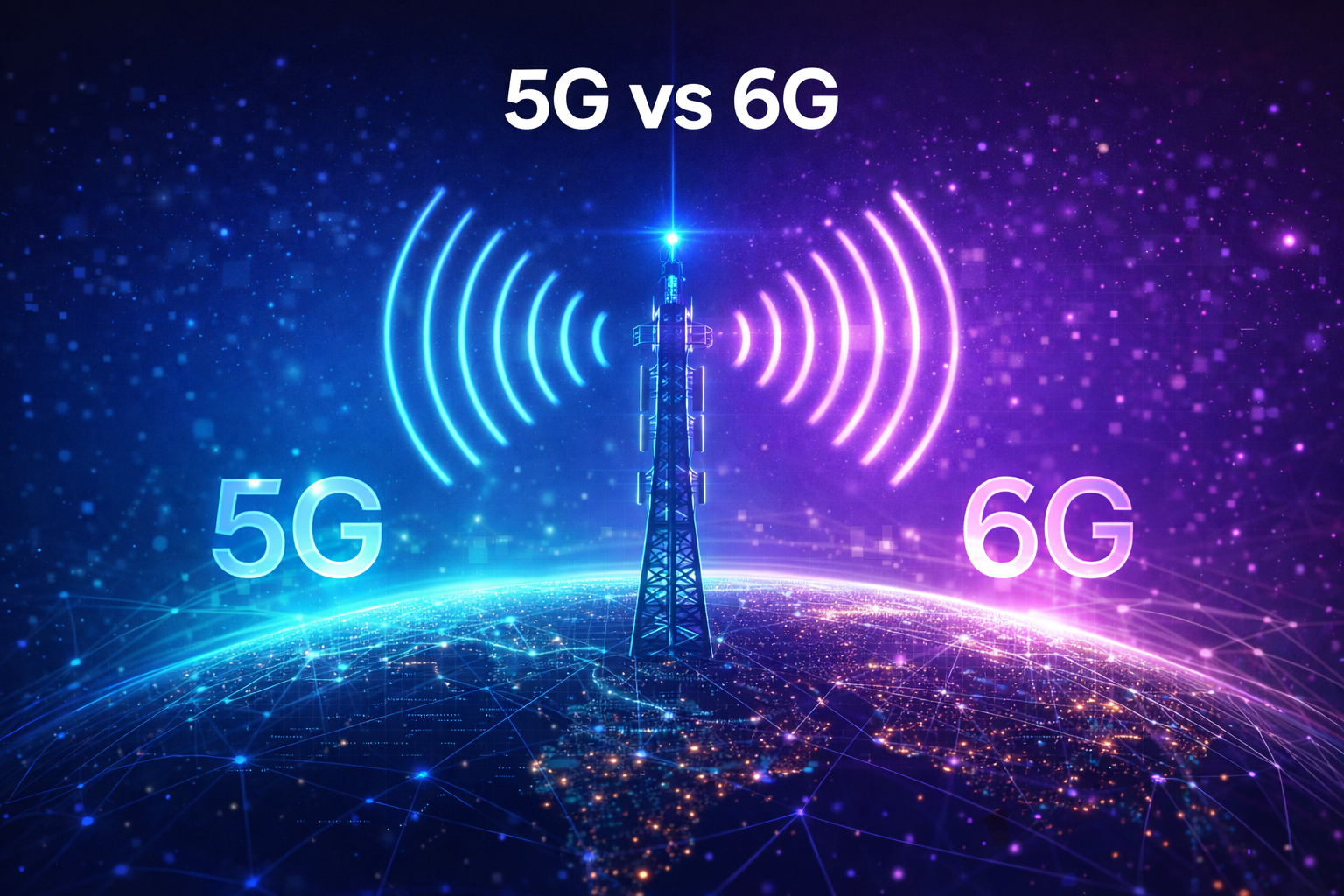
Mobile internet has evolved rapidly—from 2G calls to 5G-powered smart devices. As 5G continues to roll out globally, a new question is already emerging: What is 6G, and how will it change our digital future?
In this article, we compare 5G vs 6G, explain key differences, and explore what the next generation of mobile internet means for users and industries.
📶 What Is 5G?
5G is the fifth generation of mobile networks, designed to deliver:
- Ultra-fast internet speeds
- Low latency
- Support for massive device connectivity
Key Benefits of 5G:
- Faster downloads and streaming
- Better performance for online gaming
- Reliable connectivity for IoT devices
5G is already powering smart cities, autonomous vehicles, and AR/VR experiences.
🚀 What Is 6G?
6G (sixth-generation wireless technology) is the future evolution of mobile internet, expected to arrive around 2030.
While still in the research phase, 6G aims to:
- Be up to 100x faster than 5G
- Use AI-driven networks
- Enable holographic communication
6G will blur the line between physical and digital worlds.
⚖️ 5G vs 6G: Key Differences
| Feature | 5G | 6G |
|---|---|---|
| Launch timeline | 2020–2026 | ~2030 |
| Speed | Up to 10 Gbps | Up to 1 Tbps (theoretical) |
| Latency | ~1 ms | Near-zero |
| Intelligence | Limited AI | AI-native networks |
| Use cases | Smart cities, IoT | Holograms, digital twins |
🌍 Real-World Use Cases of 6G
🔹 1. Holographic Communication
Real-time 3D holograms for meetings and education.
🔹 2. Advanced Smart Cities
6G will support:
- Autonomous traffic systems
- City-wide digital twins
- Instant emergency response
🔹 3. Healthcare & Remote Surgery
Ultra-low latency will allow doctors to perform surgeries remotely with precision.
🔹 4. Metaverse & XR Experiences
Fully immersive virtual worlds with real-world responsiveness.
🤖 Role of AI in 6G Networks
Unlike 5G, 6G will be AI-native:
- Self-optimizing networks
- Predictive maintenance
- Intelligent bandwidth allocation
AI will manage network traffic in real time.
⚠️ Challenges Ahead
- High infrastructure costs
- Energy efficiency concerns
- Spectrum availability
- Security and privacy risks
Governments and tech companies are already investing in solutions.
🔮 Future of Mobile Internet
The transition from 5G to 6G will:
- Enable new digital economies
- Transform communication
- Support AI-driven societies
5G builds the foundation, while 6G defines the future.
✨ Final Thoughts
5G is changing the world today, but 6G will redefine what’s possible tomorrow. While 6G is still years away, understanding its potential helps businesses and individuals prepare for the next digital revolution.
The future of mobile internet is faster, smarter, and more immersive than ever.
Quantum Computing: The Next Big Technology Revolution click here..
Web3 and Decentralization: The Future of the Internet click here…
Quantum Computing for Beginners: Why It Matters More Than You Think click here…